

The eastern Andes of northern Peru — the montane forests and páramos of Amazonas, San Martín and Cajamarca — are part of the Tropical Andes biodiversity hotspot: the greatest biological richness on the planet. Altitude, microclimates, fertile soils, humidity and biological diversity converge here to produce native crops of exceptional nutritional and functional value.
This territory is not just a geography. It is a natural productive asset — a place capable of generating foods with attributes of origin, quality and sustainability that almost nowhere else on Earth can match.
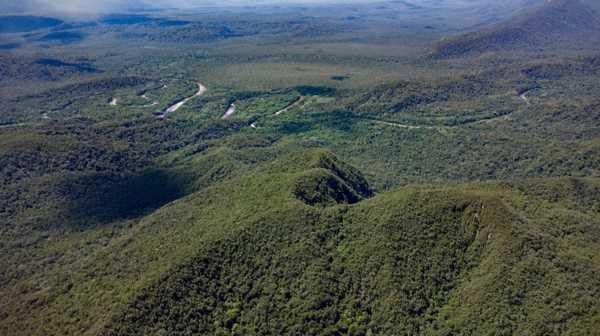
North of Alto Mayo, encircled by the Andean Tepuis between the Marañón and Huallaga rivers, Valle Escondido is one of the best-preserved ecosystems left within the Tropical Andes hotspot.
Over 80% of the valley is legally owned by five Awajún communities. We work with the two largest — Mantaga and Achu — who together safeguard a contiguous expanse of forest, with only a small number of families standing as the line between the forest and the deforestation pressure of the Alto Mayo migration corridor.
In recent years, our partners and the Awajún communities have documented a minimum of dozens of mammal species from the IUCN Red List — including endangered monkey species, the giant otter, the Andean bear, the tapir, peccaries, armadillos, and the giant anteater.
The Awajún of Mantaga and Achu receive support from the Peruvian state conservation programs — backing services for families and seeding sustainable economies tied to forest stewardship. Three living-product lines are in development.
A vanilla-processing initiative is in development in Alto Mayo, with the community pursuing gourmet products and extracts to organic and food-safety standards. Specialty-scale production for export markets is the medium-term goal.
Production of Croton lechleri — "dragon's blood" — a regenerating tree resin long used in Amazonian medicine for wound-healing and immune support. Wild-harvested under community management.
Honey from stingless native bees — a functional superfood with antioxidant and antimicrobial properties unmatched by Apis honey, and a powerful incentive to protect flowering forest.
Primary forest and páramo are being lost to logging, burning, shifting agriculture, informal mining, and overgrazing. Once gone, neither comes back at human timescales.
The narrow microclimates that grow the world's finest coffee, cacao and native crops are shifting. Growing cycles are changing; pests and disease are rising.
Producers face wild swings in international commodity prices and limited access to financing, leaving farms unable to invest in quality or sustainability — and rural youth leaving for the city.
Strengthening the economies of forest-stewarding communities is not separate from conservation — it is conservation. Every premium price paid, every long-term partnership, every kilometre of supply chain we shorten, makes it more possible for these families to remain on the land they have always protected.